How Often Should You Get a Wheel Alignment? The 10,000-Mile Truth for Alabama Drivers
If you have searched “how often wheel alignment” should be checked, you have probably seen several different answers. Some recommendations mention every 6,000 miles. Others say once a year, while some drivers wait until the steering wheel feels crooked or the tires start wearing unevenly.
So, what is the practical answer for drivers in Crossville, AL?
For most vehicles, a good rule of thumb is to have the wheel alignment checked every 10,000 to 12,000 miles or once a year, whichever comes first. However, mileage is only a starting point. Road conditions, driving habits, vehicle use, and warning signs can all mean your vehicle needs an alignment sooner.
At Mike’s Alignment & Tire Services Inc, we have helped local drivers protect their tires and improve vehicle handling for more than 35 years. Here is how to know when your vehicle really needs alignment service.
The 10,000-Mile Rule Is a Starting Point
A yearly alignment check or an inspection around every 10,000 to 12,000 miles works well for many drivers who use their vehicles under normal conditions. It is also convenient to have your alignment checked during a tire rotation, tire replacement, or another scheduled maintenance visit.
That interval helps identify gradual changes before they become expensive problems. Your vehicle’s alignment can shift slowly as suspension components age, or it can change suddenly after one hard impact.
An alignment check is especially worthwhile when:
- You install a new set of tires.
- You have suspension or steering work completed.
- Your vehicle has been involved in a collision.
- You hit a pothole, curb, or rough patch of road.
- You notice a change in steering or handling.
The best interval for your vehicle may also be listed in the owner’s manual or maintenance schedule. The important point is not to treat 10,000 miles as a guarantee that everything is still within specification. It is a sensible maintenance benchmark, not a substitute for paying attention to how your vehicle drives.
Alabama Roads Can Change Your Alignment Faster
Drivers around Crossville and neighboring communities understand that road conditions can vary from one route to the next. A smooth highway commute places different demands on a vehicle than a daily trip over uneven backroads.
Potholes are one of the most common causes of sudden alignment problems. A sharp impact can affect the angles of the wheels or damage a steering and suspension component. You may not notice a problem immediately, but uneven tire wear can begin soon afterward.
Local driving conditions that may require more frequent alignment checks include:
Potholes and rough pavement
Heavy rain and changing weather can make existing pavement damage worse. If your vehicle takes a hard hit, pay attention to whether the steering wheel is suddenly off-center or the vehicle begins drifting.
Marshall County backroads and uneven routes
Drivers traveling through Marshall County backroads and other rural routes may encounter uneven pavement, patched surfaces, and changing road edges. These conditions can gradually put additional stress on the suspension.
Gravel farm roads
Gravel and farm roads are especially relevant for local farmers, truck owners, and people who regularly travel between fields, barns, and job sites. Repeated bumps and loose surfaces can contribute to alignment changes and accelerated tire wear.
Hot Alabama summers
High summer temperatures increase tire pressure and heat buildup, especially during long drives or when a vehicle is carrying heavy loads. Heat does not automatically knock a vehicle out of alignment, but it can make existing tire wear and suspension problems more noticeable. Tires that are already scrubbing against the pavement because of poor alignment may wear even faster in hot conditions.
If your vehicle sees a combination of rough roads, gravel, heavy loads, and frequent highway driving, an annual inspection may not be enough. It is wise to have the alignment checked whenever the vehicle’s handling changes.
Warning Signs You Should Not Ignore
Your vehicle may need a wheel alignment before it reaches the 10,000-mile mark. In many cases, the tires and steering will provide an early warning.
Your vehicle pulls to one side
On a reasonably level road, your vehicle should track straight with only minor steering correction. If it consistently pulls left or right, check the tire pressures first. If the pressures are correct and the pulling continues, alignment should be inspected.
A pull can also be caused by a tire problem, worn suspension component, or brake issue. A professional inspection helps identify the actual cause instead of guessing.
The steering wheel is crooked
If the vehicle travels straight while the steering wheel sits noticeably tilted, the alignment may be out of specification. An off-center steering wheel can also indicate that the front and rear wheels are not tracking together properly.
The tires are wearing unevenly
Look for excessive wear on the inside or outside edge of a tire, feathered tread blocks, or one tire wearing faster than the others. These patterns can indicate alignment trouble.
Uneven wear is more than a sign that your tires look different. It reduces the useful life of the tread and may affect traction, braking, and handling. Correcting alignment early can help protect the investment you made in your tires.
The vehicle feels unstable or wanders
A vehicle that feels loose, wanders on the highway, or requires constant steering corrections should be inspected. Alignment may be part of the problem, but worn tie rods, ball joints, shocks, or other suspension components can create similar symptoms.
You hear tire squealing during normal turns
A small amount of tire noise during aggressive cornering is normal. Squealing during ordinary low-speed turns, however, can indicate that a tire is scrubbing across the pavement instead of rolling smoothly.
Why Proper Alignment Helps Your Tires and Handling
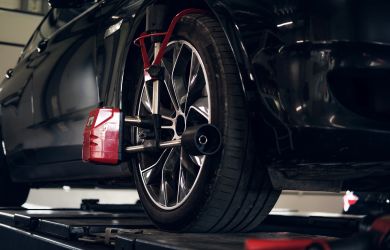
A wheel alignment adjusts the direction and angle of the wheels so they match the vehicle manufacturer’s specifications. The process involves measuring angles such as camber, caster, and toe, then making the appropriate adjustments when possible.
When the wheels are aligned correctly:
- The tires make more consistent contact with the road.
- Steering feels more predictable.
- The vehicle tracks straighter.
- Tire wear is more even.
- The suspension works as intended.
- The vehicle may roll more efficiently.
Alignment will not repair a damaged tire or replace a worn suspension component. If a part is bent or excessively worn, that issue may need to be addressed before a precise alignment can be completed. This is why a proper alignment service includes inspection rather than simply making adjustments without looking for the underlying cause.
At Mike’s Alignment & Tire Services Inc, our technicians use state-of-the-art alignment equipment to measure the vehicle accurately and make adjustments according to the manufacturer’s specifications. Our goal is not just to make the steering wheel look straight. It is to help your vehicle handle properly and reduce unnecessary tire wear.
When New Tires and Alignment Service Go Together
New tires are a significant investment, whether you drive a commuter car, work truck, lifted Jeep, ATV, or agricultural equipment. Installing new tires on a vehicle with poor alignment can lead to uneven wear before the tires have had a chance to deliver their full service life.
That is why an alignment check is recommended when you purchase new tires, particularly if the old set showed uneven wear. Correcting the alignment gives the new tires a better starting point and helps you get the value and performance you expect.
Mike’s has access to a wide range of tire brands and sizes through the American Tire Distributors network. We can help source tires for passenger vehicles, trucks, ATVs, lawn equipment, and agricultural applications, then pair tire installation with the inspection and alignment service your vehicle needs.
The Bottom Line for Alabama Drivers
So, how often should you get a wheel alignment? For many drivers, every 10,000 to 12,000 miles or once a year is a reasonable maintenance schedule. But drivers who regularly travel pothole-damaged roads, gravel farm routes, or rough backroads may need service sooner.
Do not wait for the mileage interval if your vehicle pulls to one side, the steering wheel is crooked, the tires are wearing unevenly, or the handling feels different. A timely inspection can help reduce tire wear, improve handling, and prevent a small issue from becoming a more expensive repair.
Mike’s Alignment & Tire Services Inc has served Crossville, AL and surrounding communities since 1988. With more than 35 years of hands-on automotive experience and precision alignment equipment, our family-owned team is ready to help you keep your vehicle driving straight.
Learn more about our tire and alignment services or call 256-659-4420 to schedule an inspection. You can also visit Mike’s Alignment & Tire Services to get started.