Cold Mornings, Low Tires: Why Fall Temps Trigger Your TPMS Light
If your TPMS light comes on during the first cool mornings of fall, your first thought may be, “I must have a flat.” Sometimes that is true, but often, the warning is simply reacting to the weather.
As temperatures fall around Crossville, AL, the air inside your tires becomes slightly less pressurized. A drop of about 10 degrees Fahrenheit can reduce tire pressure by roughly 1 PSI. That may not sound like much, but a few cooler mornings can push a tire below the vehicle manufacturer’s warning threshold.
The result is a dashboard light that appears just as you are heading to work, school, or down the backroads of DeKalb County.
Cold weather does not mean you should ignore the light. It means you should know how to interpret it and check your tires properly.
What Your TPMS Actually Monitors
The Tire Pressure Monitoring System, or TPMS, is designed to alert you when one or more tires are significantly underinflated. Most systems fall into one of two categories.
Direct TPMS Sensors Measure Pressure Inside the Wheel
A direct system uses a small electronic sensor attached to the wheel, usually as part of the valve stem. It measures the actual air pressure inside the tire and sends that information to the vehicle.
If the pressure drops below the programmed warning level, the TPMS light comes on. Some vehicles also display the pressure reading for each individual tire.
Direct systems are especially likely to react to a cold snap because they measure real pressure changes. If a tire was already a few PSI low, a cool overnight temperature can be enough to trigger the warning.
Indirect TPMS Uses the ABS System
An indirect system does not measure tire pressure directly. Instead, it uses the vehicle’s anti-lock braking system and wheel-speed sensors to compare how quickly the tires rotate.
A tire with lower pressure has a slightly smaller rolling radius. It may rotate faster than the others, allowing the vehicle’s computer to estimate that a tire is underinflated.
Indirect TPMS systems can be useful, but they may respond differently from direct systems. A uniform pressure drop across all four tires can sometimes be harder for the system to identify because the tires are still rotating at similar speeds. Depending on the vehicle, the system may also need to be reset or recalibrated after adjusting the tire pressures.
You can learn more about the basic differences between these systems through your vehicle owner’s manual or manufacturer resources.
Why Cold Mornings Turn the Light On
The commonly used rule is simple: for every 10°F change in temperature, tire pressure changes by approximately 1 PSI.
For example, imagine your tires were checked on a warm afternoon when it was 70°F. If the temperature drops to 30°F overnight, the tires may lose around 4 PSI simply because the air inside them has contracted.
That pressure change is added to normal air loss. Tires naturally lose a small amount of pressure over time, even when they do not have a puncture. A valve stem, bead seal, or tiny tread puncture can also allow air to escape slowly.
Most TPMS systems are designed to warn you when a tire is about 25% below the recommended cold pressure. On a vehicle that calls for 35 PSI, the warning threshold may be near 26 PSI. A tire that was already slightly low at the end of summer can reach that level when fall temperatures arrive.
This is why the first real cold mornings around Crossville often bring a wave of TPMS warnings.
Does the Light Go Off After You Drive?
It may.
After several minutes on the road, the tires warm up from flexing against the pavement. The air inside them expands slightly, which raises the pressure. That can move the tire back above the TPMS warning threshold and cause the light to turn off.
However, the tire may still be underinflated.
A warning that disappears after driving is not proof that the tire is properly filled. It may simply mean the tire warmed enough to stop triggering the sensor. Underinflation can still affect handling, fuel economy, and tread life.
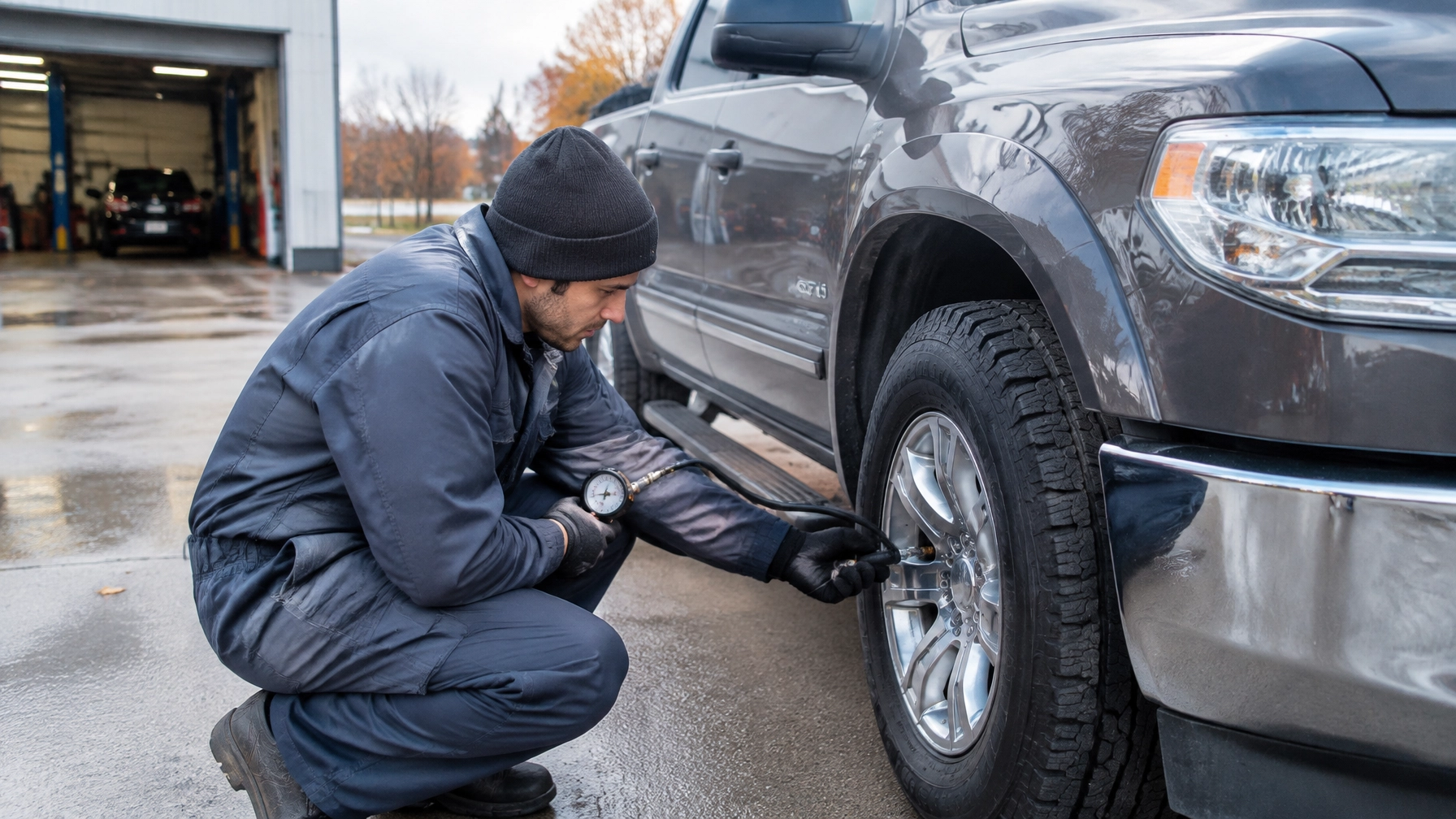
For accurate pressure readings, check the tires when they are cold, ideally after the vehicle has been parked for at least three hours. Use the pressure listed on the driver’s door-jamb label or in the owner’s manual, not the maximum PSI printed on the tire sidewall.
How to Tell a Temperature Change from a Real Leak
A cold-weather TPMS warning deserves attention, but it does not automatically mean you have a puncture. Use a few simple observations to determine what may be happening.
Check All Four Tires with a Gauge
Do not rely only on the dashboard display. Use a quality tire-pressure gauge and check every tire, including the spare if your vehicle monitors it.
If all four tires are similarly low, a temperature change or normal seasonal air loss is more likely. If one tire is several PSI lower than the others, a leak becomes more likely.
Watch What Happens After Inflation
Inflate the tires to the manufacturer’s recommended cold pressure. If the light remains on, follow the vehicle’s reset or relearn procedure if required.
If the light comes back soon afterward, the tire may have a puncture, leaking valve, damaged wheel, or bead-seal problem.
Check the Same Tire Over Two or Three Days
A slow leak may not be obvious during one inspection. Check the same tire at roughly the same time each morning for two or three days.
A tire that repeatedly loses pressure while the other tires remain steady needs to be inspected. Look for nails, screws, cuts, sidewall damage, or a valve stem that may be leaking. Avoid pulling an object out of the tread before the tire can be examined; it may be helping slow the air loss.
If you have searched for “tire repair near me” because a TPMS warning keeps returning, professional inspection is the safest next step.
Could an Aging TPMS Sensor Be Causing the Warning?
Direct TPMS sensors use sealed batteries. Those batteries are not normally recharged or replaced individually; when the sensor battery reaches the end of its service life, the sensor typically needs to be replaced.
Many TPMS sensor batteries last approximately five to ten years, depending on the vehicle, sensor design, climate, and driving conditions. That means original sensors on some 2016–2020 vehicles may be entering the inspection or replacement window in 2026.
A weak sensor can produce inconsistent readings or stop communicating altogether. Pay attention to the type of warning:
- A solid TPMS light commonly indicates low tire pressure.
- A light that flashes before staying on may indicate a TPMS system fault.
- A “TPMS fault” message or missing pressure reading can point to a sensor or communication problem.
- A warning that returns even when pressures are correct may require sensor testing.
Not every 2016–2020 vehicle will need new sensors today, and indirect TPMS systems do not use a battery-powered pressure sensor inside each wheel. Testing the system is the best way to identify the actual cause.
Underinflation Affects More Than the Dashboard
Driving on underinflated tires creates extra flex in the sidewalls. That additional heat and movement can lead to several problems.
Faster Shoulder Wear
When a tire is underinflated, more of the tread’s outer shoulders may carry the load. Over time, the shoulders can wear faster than the center of the tread.
Lower Fuel Economy
Underinflated tires create more rolling resistance. Your engine has to work harder to move the vehicle, which can reduce fuel economy, especially during frequent stops, short trips, and rural driving.
Less Predictable Handling
Low pressure can make steering feel slower or less precise. It may also affect braking, cornering, and stability on wet roads.
Alignment Problems Can Hide in the Tread
Uneven wear is not always caused by pressure alone. Incorrect toe, camber, worn suspension parts, or a bent wheel can also damage the tread.
That is why a fall tire inspection should include more than adding air. If you see feathering, cupping, or one-sided wear, ask about a wheel alignment. Precision alignment helps your vehicle track properly, improves handling, and helps protect your tire investment.

Fall Is the Right Time for a Complete Tire Check
October is a practical time to prepare your vehicle for colder mornings and winter travel. Before temperatures fall further, have the tires checked for:
- Correct cold inflation pressure
- Tread depth and uneven wear
- Punctures, cracks, and sidewall damage
- Valve stem or bead leaks
- TPMS sensor operation
- Wheel balance and alignment
- Spare tire condition and pressure
The same preparation matters for farmers and equipment owners. Agricultural tires, ATV tires, and lawn equipment may sit for weeks through cold snaps. When equipment is parked, a slow leak can go unnoticed until the tire is needed. Checking pressure and inspecting the sidewalls before the next job can prevent avoidable downtime.
At Mike’s Alignment & Tire Services, we provide full-service tire and automotive care for passenger vehicles, trucks, lifted Jeeps, ATVs, agricultural equipment, and lawn equipment. We can source any tire brand or size quickly through our extensive tire network, including agricultural options from brands such as Firestone, Titan, BKT, and Goodyear.
Our family-owned business has served Crossville since 1988. With more than 35 years of automotive experience, we handle tire sales and installation, tire repairs, TPMS service, balancing, wheel alignment, oil changes, A/C repairs, and other general automotive maintenance.
Don’t Panic, but Don’t Ignore the Light
A TPMS light on a cold October morning may be caused by nothing more than a seasonal pressure drop. Still, it is a safety warning, not a nuisance to dismiss.
Check the pressure when the tires are cold, compare the same tire over two or three days, and have the system inspected if the warning returns, flashes, or does not match the actual tire pressure. Fall is also an ideal time to identify uneven tread wear or alignment issues before winter weather and longer road trips put additional demands on your vehicle.
If you are in Crossville, AL, or traveling the DeKalb County backroads, stop by Mike’s Alignment & Tire Services for a free, quick pressure and tread check before the cold sets in. Contact us or call to schedule tire service, a TPMS inspection, or a precision wheel alignment.